TL;DR: In brief
A female king called Ankhkheperure Neferneferuaten ruled briefly between Akhenaten and Tutankhamun. Mainstream scholarship led by Aidan Dodson identifies her as Nefertiti; this essay sets out why The Amarna Mysteries adopts an alternative reading, identifying her with the Younger Lady (KV35YL), presented as one defensible reading of the same ambiguous evidence rather than a claim to have settled the debate. It also weighs whether her reign began beside a living Akhenaten or only at his death — the series follows the posthumous reading.
One of the most debated questions in Amarna studies is the identity of Pharaoh Ankhkheperure Neferneferuaten, the female king who ruled briefly between Akhenaten’s death and Tutankhamun’s coronation. The mainstream reading, championed most thoroughly by Aidan Dodson in Nefertiti, Queen and Pharaoh of Egypt, identifies this ruler as Nefertiti herself. It is a carefully constructed argument supported by significant evidence.
I should be clear about what I am and what I am not. I am not a professional Egyptologist. I am a writer of historical fiction who has read the scholarship as closely as I can, particularly the 2010 Hawass DNA study, the skeletal analyses of the KV55 mummy, and the titulary inscriptions, and who has made specific interpretive choices for The Amarna Mysteries based on that reading. Where the evidence is clear, I have followed it. Where it permits more than one reading, I have chosen the interpretation that I believe best fits the overall pattern. Professional scholars may well disagree with some of these choices, and they are far better qualified than I am to make that judgment. This is a popular-audience, authorial interpretation built on existing scholarship; where I take a position it is because it best serves the story and fits one defensible reading of the evidence.
This article explains the reasoning behind the interpretation adopted in the series. Readers of The Poisoner’s Throne will recognize elements of it in the novel’s Prologue, but this article goes into more detail about the reasoning behind those choices.
Two Kings Named Ankhkheperure
For most of the twentieth century there seemed to be no mystery here at all. The throne name Ankhkheperure was assumed to belong to a single ruler — the shadowy young king Smenkhkare — and the feminine forms of the name that kept surfacing were explained away as carving errors. Since J.R. Harris argued in the early 1970s that Nefertiti had reigned as a king in her own right, that assumption has steadily come apart.
The decisive work was philological. James P. Allen showed that the surviving cartouches divide into two consistent patterns. Where the names carry epithets referring to Akhenaten — “beloved of Waenre,” “effective for her husband” — the ruler is the female Neferneferuaten, and the throne name frequently takes a feminine t: Ankhetkheperure, the grammar of a woman on the throne. Where the throne name stands plain, the ruler is the male Smenkhkare. Two kings, not one, each using Ankhkheperure — and nearly everything written on the question since builds on that separation.
Allen’s own conclusions are a lesson in how unstable this ground remains. In The Amarna Succession (2009) he identified the female king as Neferneferuaten-tasherit, the fourth daughter of Akhenaten and Nefertiti, largely because he believed Nefertiti herself was already dead. Then came the Dayr Abu Hinnis inscription (discussed later in this article), which put Nefertiti alive and still queen in Akhenaten’s Year 16. Allen withdrew the proposal, and in The Amarna Succession Revised (2016) concluded that the coregent had been Nefertiti after all. When one of the field’s most careful philologists reverses himself within a decade — on new evidence, which is exactly how scholarship is supposed to work — it is a fair warning about how little in this debate is fixed.
The Scholarly Case for Nefertiti
The case for identifying Nefertiti as Neferneferuaten is strong, and it deserves a fair hearing.
First, the shared name. From around Year 4/5 of Akhenaten’s reign onward, Nefertiti’s full cartouche name was Neferneferuaten-Nefertiti. The female pharaoh’s nomen was Neferneferuaten. The overlap is striking and, for many scholars, compelling.
Second, Nefertiti’s exceptional status during Akhenaten’s reign. She was depicted smiting enemies, a pose traditionally reserved for the pharaoh, in imagery that was part of the broader Amarna artistic revolution. She wore crowns associated with kingship. Her titles and epithets went far beyond what was typical for a Great Royal Wife.
Third, the KV62 box fragment. A broken box lid from Tutankhamun’s tomb (Cairo JE61500a) names Akhenaten, Neferneferuaten, and Queen Meritaten — transliterated “Meryetaten” by Dodson and some other Egyptologists — in precisely the positions where one would expect Akhenaten, Nefertiti, and their eldest daughter. The absence of Smenkhkare despite the presence of his wife has been read as indicating that Meritaten was now a widow.
Fourth, the epithet. Marc Gabolde’s 1998 discovery that Neferneferuaten’s nomen sometimes carried the epithet akhet-en-hi.es, meaning “beneficial for her husband,” points to a woman who had been married to a king. Allen and Gabolde’s reassessments (published in 2009) of the palimpsest inscriptions on the four miniature gold canopic coffinettes from KV62 — which had held Tutankhamun’s mummified viscera — confirmed that wherever the nomen’s epithet could be detected, it read akhet-en-hi.es. Those who identify the king as Nefertiti take this as further evidence pointing to her, though Gabolde himself used the epithet to argue for Meritaten. Nefertiti was unquestionably Akhenaten’s principal wife.
Fifth, the arc Nicholas Reeves traces through the names themselves. Where most scholars now see two successive rulers sharing a throne name, Reeves reads a single woman moving through successive identities: the queen Neferneferuaten-Nefertiti becomes the coregent Ankhkheperure Neferneferuaten, who finally rules alone in male style as Ankhkheperure Smenkhkare-Djeserkheperu. On this reading there was never a separate Smenkhkare at all — every stage of the sequence is Nefertiti. It is the boldest version of the Nefertiti case, and it stands or falls as a whole.
Reeves carried the argument into archaeology in The Burial of Nefertiti? (2015), proposing that high-resolution scans of Tutankhamun’s burial chamber preserve the traces of a sealed doorway in its north wall — and that beyond it, undisturbed, lies the pharaonic burial of Nefertiti, with KV62 itself merely the outer chambers of her tomb. The proposal made headlines around the world. Successive ground-penetrating radar surveys returned contradictory results, and the most systematic campaign, a 2018 survey by a team from the Politecnico di Torino published by Luigi Sambuelli and colleagues, reported no evidence of hidden chambers; the theory is unproven, and most Egyptologists doubt it. But it shows how much rides on the identification: if Neferneferuaten was Nefertiti, buried as a king, her tomb has never been found.
These are substantial arguments. Dodson himself acknowledges that absolutely unequivocal evidence remains elusive, but he considers Nefertiti the overwhelmingly obvious candidate. I have great respect for his work, which has been one of the foundational sources for the entire series. The interpretation I have adopted differs from his, and what follows is my attempt to explain why.
Year 3: A Prayer to Amun in a Theban Tomb
The single most important document for Neferneferuaten’s reign is not a monument but a graffito: a prayer written in ink on the wall of the Theban tomb of Pairi (TT139). It is dated to Year 3, third month of the Inundation, day 10, of her reign, and her cartouches there carry the epithets “beloved of the Aten” and “beloved of Waenre” — the second tying her explicitly to Akhenaten, whose throne name was Neferkheperure-Waenre. It is the only fixed date her reign has ever yielded. Whoever she was, she ruled long enough to count her own regnal years, and at least into a third of them.
The prayer is the work of a lay priest named Pawah, “scribe of the divine offerings of Amun in the Mansion of Ankhkheperure,” set down on the wall by his brother, the draughtsman Batjay. And it is addressed not to the Aten but to Amun — the god the regime had spent a decade erasing. Its language is the language of absence and longing: a priest begging a banished god to come home, and to let those who ache for the sight of him see him again.
The implications are considerable. By her third year, divine offerings of Amun were again being administered by an institution that bore her own throne name. The reconciliation with the old cult — the process usually credited to Tutankhamun’s restoration — had already begun under the female king. And the graffito is scrupulously neutral on the question this article is about: it dates her, it ties her to Akhenaten, it shows Amun stirring again under her name, and it never says who she was.
The DNA Evidence: What It Reports and What It Leaves Open
The 2010 DNA study published in JAMA reported several relationships among the Amarna royal mummies. Tutankhamun was identified as the son of the KV55 male and the KV35 Younger Lady. Those two individuals were identified as full siblings: both children of Amenhotep III and Queen Tiye. The Elder Lady from the same tomb was identified as Tiye herself.
These core findings are widely accepted, though a letter to JAMA from Eline D. Lorenzen and Eske Willerslev questioned the study’s genetic data that same year, and Marc Gabolde, with Dodson after him, has argued that the same genetic signature could arise from stacked first-cousin marriages without requiring sibling parents at all.
What remains genuinely open is the identity of the KV55 male. The study’s authors identified him as “most probably Akhenaten,” but acknowledged this was a preferred interpretation rather than the only one consistent with the data. The genetic profile identifying someone as “son of Amenhotep III and Tiye” and “father of Tutankhamun” would apply equally to any full brother of Akhenaten. Both brothers would have inherited their alleles from the same two parents, and the study’s markers can identify whose children they were but cannot determine which son of that couple is being tested.
This ambiguity is what opens the door to an alternative reading: that the KV55 male might be Smenkhkare rather than Akhenaten.
The KV55 Skeletal Age Question
The KV55 skeleton — conventionally identified as Akhenaten, though increasingly read as Smenkhkare, whose origin is unresolved (the series makes him Akhenaten’s younger brother) — has been studied repeatedly since its discovery in 1907, and the age at death has been a persistent source of disagreement. The majority of assessments place it in the early twenties. Grafton Elliot Smith estimated 25 to 26 years (with a margin of error of two to three years) in 1912. Douglas Derry revisited the remains in 1931 and concluded that they were too young to be Akhenaten. Harrison concluded a range of 17 to 25 years in 1966.
The 2010 CT scan suggested a significantly older age, 35 to 45, but Brenda J. Baker disputed it in a letter to JAMA that year, reading what Elliot Smith and Harrison recorded of the growth plates, the skull sutures and an upper wisdom tooth as 18 to 23 years. From that age at death, she concluded that the KV55 man was another of Amenhotep III’s sons. The Spitalfields study of 18th and 19th century remains with known ages of death has shown that skeletal aging of pre-modern remains can involve systematic errors, with some younger individuals appearing considerably older by standard criteria. Dodson discusses this finding and considers it supportive of the lower age estimates.
Akhenaten reigned for 17 years. Even if he came to the throne as young as 15, he would have been at least 32 at death. If the majority of skeletal assessments are correct, the KV55 body is too young to be Akhenaten. Dodson himself concludes that if the majority view is correct, “the body cannot be that of Akhenaten, leaving Smenkhkare as the only candidate.” Other studies, including CT-based work, have argued for an older age, so the matter is not settled; but Smenkhkare remains the most widely proposed alternative.
The KV21A Question
There is another piece of the puzzle that I found particularly significant when deciding how to construct the genealogy for the series.
The 2010 DNA study also examined the KV21A mummy and found her profile partially compatible with being the mother of the two stillborn girls (317a and 317b) found in Tutankhamun’s tomb, who, in the study’s words, “can be” Tutankhamun’s daughters. The authors noted, however, that the data were “not statistically significant to define her as Ankhesenamun.” If KV21A is nonetheless Ankhesenamun, as many scholars treat as likely given that she is Tutankhamun’s only known wife, that identification has implications for the KV55 question.
However, KV21A’s DNA does not match the KV55 skeleton as her father. This is a different kind of test from the one that cannot distinguish between brothers. While both Akhenaten and Smenkhkare inherited alleles from the same parents, each received a different combination at each locus. A paternity test checks whether a child carries one allele from the proposed father at every tested marker. If the numbers don’t match at even one locus, paternity is excluded. The KV55 skeleton’s surviving alleles do not match KV21A’s at the markers where both can be read — though only one of KV21A’s two alleles was recovered at each of those markers, so this falls short of a decisive exclusion — while Akhenaten, carrying a different combination from the same parents, could have had the right ones.
Historical records confirm that Ankhesenamun was Akhenaten’s daughter. If KV21A is Ankhesenamun, then KV55 is unlikely to be Akhenaten; if KV55 is Akhenaten, then KV21A is unlikely to be Ankhesenamun. On the alleles recovered so far, the two identifications sit uneasily together.
Mainstream scholarship generally treats the KV21A identification as tentative and retains KV55 as Akhenaten. For the series, I chose the opposite resolution: accepting KV21A as Ankhesenamun and KV55 as Smenkhkare. This is not because I believe the scholarly consensus is mistaken, but because this reading resolves more of the apparent contradictions in the evidence simultaneously, and because it provided the strongest foundation for the story I wanted to tell.
Two points of context. First, Dodson agrees that KV55 is most probably Smenkhkare, and he explores pathways by which Nefertiti could still be Tutankhamun’s mother. The reconstruction in The Amarna Mysteries takes a different view on this parentage question, following the straightforward reading that the Younger Lady is Tutankhamun’s biological mother. Since Dodson also identifies Nefertiti as the pharaoh Neferneferuaten, those pathways would join both roles in one woman, but they rest on stacked generations of first-cousin marriage to square her with the full-sibling DNA. The series takes the more direct route, reading the Younger Lady as the literal sister and partner of Smenkhkare, and the genetics at face value. The case for that simpler reading follows.
The Younger Lady in the Series
If the KV55 male is Smenkhkare rather than Akhenaten, then Tutankhamun’s mother, the Younger Lady, was the sister of both men: a daughter of Amenhotep III and Tiye.
Amenhotep III and Tiye had several daughters, most poorly attested in the historical record: Sitamun (elevated to Great Royal Wife), Iset, Henuttaneb, Nebetah, and possibly Beketaten. The Younger Lady was likely one of these princesses who became the partner of her brother Smenkhkare and bore Tutankhamun.
A statistical analysis by Juan Antonio Belmonte strengthens this reading. The genetics are not intuitive, but the logic is worth walking through.
At every tested locus, the Younger Lady has one allele that matches Amenhotep III and one that matches Tiye. This is exactly what you would expect from their daughter. The question is whether a granddaughter could show the same pattern.
Consider Meritaten, the most commonly proposed granddaughter candidate. She was the daughter of Akhenaten and Nefertiti. Akhenaten was a son of Amenhotep III and Tiye, so at each locus he carried one allele from each of his parents. When he fathered a child, he passed along only one of his two alleles at each marker. For Meritaten to look genetically identical to a direct daughter of Amenhotep III and Tiye, Akhenaten would have needed to pass along, at every single tested locus, only those alleles he had inherited from Amenhotep III and none of the ones he had inherited from Tiye, or vice versa. At each tested locus, independently, only a narrow combination of inheritances would produce the match, so the chance of the pattern holding across all eight markers is very low.
But there is a second problem. Nefertiti’s contribution matters too. For a granddaughter to perfectly mimic the profile of a daughter of Amenhotep III and Tiye, Nefertiti’s alleles would need to match Tiye’s at every locus where Akhenaten’s matched Amenhotep III’s, or match Amenhotep III’s at every locus where Akhenaten’s matched Tiye’s. The most straightforward way this could happen is if Nefertiti herself were also a child of Amenhotep III and Tiye, making Akhenaten and Nefertiti full siblings.
This argument is not conclusive on its own — the exact probability depends on how closely the family’s founders were already related — but its direction is clear. Taking the main variables together, Belmonte put the combined probability of a granddaughter reproducing a direct daughter’s profile at less than 6%. A granddaughter would have to clear an improbable genetic hurdle at every tested locus to mimic a direct daughter; the daughter reading asks for no such coincidence. On the genetic evidence, the Younger Lady’s profile is most naturally read as that of a daughter of Amenhotep III and Tiye, not a granddaughter.
The DNA also helps constrain several other candidates. The Younger Lady is unlikely to be Nefertiti, who never held the title “King’s Daughter” and whose family background connects her to Ay’s household rather than to the royal line of Amenhotep III — though Marianne Luban has argued the Nefertiti identification cannot be dismissed on genetic grounds alone. She cannot be Meritaten, who was Akhenaten’s daughter rather than his sister, nor Kiya, who was never titled as a king’s daughter or sister.
Belmonte’s position is similar. His statistical argument supports identifying the Younger Lady as a daughter of Amenhotep III and Tiye, married to KV55 (whom he also reads as Smenkhkare), and as the mother of Tutankhamun, a reconstruction the series follows directly. On Neferneferuaten’s identity, Belmonte’s preferred reading is Nefertiti, though he notes that Meritaten cannot a priori be ruled out. The further step I take, identifying the Younger Lady herself with Neferneferuaten, is one that Belmonte does not consider rather than one he has weighed and dismissed.
I think this distinction matters. Neither the Nefertiti identification nor the Younger Lady identification is established by direct inscriptional evidence. No text names any woman with the full pharaonic titulary of Ankhkheperure Neferneferuaten and an unambiguous personal name. Both identifications are inferences from circumstantial patterns, and the series’ reading sits alongside the majority reconstruction rather than beneath it.
In The Amarna Mysteries, the Younger Lady is an unnamed sister of Akhenaten: the biological mother of Tutankhamun and the woman who ruled briefly as Pharaoh Ankhkheperure Neferneferuaten. That identification is speculative — plausible and defensible, but not proven. I present it explicitly as the narrative choice underpinning the novels.
The Shared Name Reconsidered
The strongest argument for the Nefertiti identification remains the shared name, and I want to be transparent about the limits of my counter-reading. “Neferneferuaten” — “Beautiful are the Beauties of the Aten” — was a theological statement as much as a personal name, and Nefertiti adopted it as a second cartouche from Year 5 onward. It is at least possible that another royal woman received the same name on being elevated to pharaonic status within the same religious framework. But possibility is not evidence: the name overlap remains the single strongest piece of circumstantial evidence in the debate.
One finding I consider particularly relevant is the Year 16 graffito from Dayr Abu Hinnis, which names Nefertiti as “Great Wife of the King” at the very end of Akhenaten’s reign — still queen, still identified by her queenly titles. No inscription has been found that names her with pharaonic titles; the transition from queen to pharaoh is inferred from the shared name and her exceptional status, not directly documented.
The Box Fragment Reconsidered
The KV62 box fragment (Cairo JE61500a) is often cited in the debate. What survives is the central strip of a broken vaulted lid; most of the box is lost. The strip names Akhenaten, King Ankhkheperure Neferneferuaten, and Queen Meritaten, and Dodson reads the absence of Smenkhkare as evidence that he was already dead. But that assumes the fragment preserves the complete set of names. Given how much is missing, Smenkhkare’s name could have stood on a portion that did not survive — an argument from absence is only as strong as the evidence is complete, and here the evidence is genuinely fragmentary.
A second box (Cairo JE61495) originally bore the cartouches of Neferneferuaten and Meritaten, later overwritten for Tutankhamun and Ankhesenamun — recycling that shows the equipment was reused but tells us nothing about who Neferneferuaten was.
A Living Coregent, or a Posthumous Ascension?
Running beneath the identity question is a second debate with real consequences for how the end of the reign is imagined: when did Neferneferuaten become king — alongside a living Akhenaten, or only once he was dead? The mainstream reconstructions give her a coregency. Several stelae from the period’s end show two kings side by side, and on the best known of them, the unfinished “Coregency Stela” (UC 410), the cartouches of Ankhkheperure Neferneferuaten were carved over an original text naming Nefertiti as queen, beside the double cartouche of Akhenaten. Allen reads the figures on these stelae as two living rulers depicted together, and Dodson’s reconstruction likewise raises Nefertiti to the coregency in the final stretch of the reign.
But the window for such a coregency is narrow, and the newest evidence has narrowed it further. The Year 16 graffito discussed above cuts the other way here too: with Nefertiti still titled Great Wife of the King in the sixteenth year of a seventeen-year reign, any coregency must be squeezed into the final months. Athena van der Perre, who published the graffito, concludes that the chance of a coregency is slim — on that arithmetic, the Year 3 prayer in Pairi’s tomb falls roughly two years after Akhenaten’s death, meaning her regnal count can have begun, at most, about a year before it. Rolf Krauss has long argued the stronger form of the case, placing the whole episode — a regent, a king, and a queen — squarely between Akhenaten’s death and Tutankhaten’s accession, with no overlap at all. The humblest physical witness to this compressed timeline, a storage jar relabelled from one reign to the next, is discussed in Succession and Aftermath.
Gabolde adds a philological hint that even the epithets may look back at a dead king. The closest parallels for the phrasing of akhet-en-hi.es, “effective for her husband,” he notes, are texts describing Isis’s care for her deceased husband Osiris: the devoted wife acting for a king already in the next world. Allen, though he favors a living coregency, concedes the force of the observation, allowing in The Amarna Succession that the epithet “might also date from a time after Akhenaten’s death.” On that reading, the most personal element of her titulary is not a coregent’s compliment but a widow’s theology — Isis standing over Osiris, a queen made king by her husband’s death.
The series takes the posthumous reading. In The Amarna Mysteries, no one shares Akhenaten’s throne while he lives: the Younger Lady assumes pharaonic authority only after his death, to hold the succession for her son, and the monuments that pair her with Akhenaten belong to that aftermath — a new king binding her legitimacy to her dead predecessor. I should flag the interpretive step honestly. The scholars named here disagree among themselves about the coregency, and none of them reads the joint stelae as posthumous compositions; Allen, for one, reads them as living kings. Extending Gabolde’s posthumous logic from the epithets to the monuments is the series’ own move, made because it fits the compressed timeline, the Year 16 graffito, and the power vacuum that opens The Poisoner’s Throne. A throne seized in a vacuum, not inherited by arrangement, is one defensible reading of this evidence — and it is the one the story needed.
The Canopic Coffinettes Reconsidered
The palimpsest evidence on the four canopic coffinettes tells a more complex story than the consensus reading allows. Dodson reads them as a three-stage object: a set originally made for Smenkhkare, never used; re-inscribed for Pharaoh Neferneferuaten as her own intended burial equipment; and finally overwritten for Tutankhamun when her reign ended badly. The interpretation adopted here reads that second stage — the Neferneferuaten inscription — as the work of the Younger Lady, claiming her predecessor’s unused equipment for her own burial.
The “beneficial for her husband” epithet, which Gabolde retranslated and others read as pointing specifically to Nefertiti (though Gabolde himself used it to argue for Meritaten), applies to any king’s sister and partner, and in the series the Younger Lady was exactly that, Smenkhkare’s full sister. The coffinettes are not evidence against the series’ reading; they are the record of a brief reign whose physical traces were systematically reassigned.
A Violent Death?
The Younger Lady’s mummy shows severe trauma to the left side of the face. (The implications for the succession crisis are significant.) A CT study quoted by Dodson suggests that the wound was likely made before mummification, by a heavy blow, one that would bring on severe shock and bleeding. If that reading holds, her end was violent rather than natural.
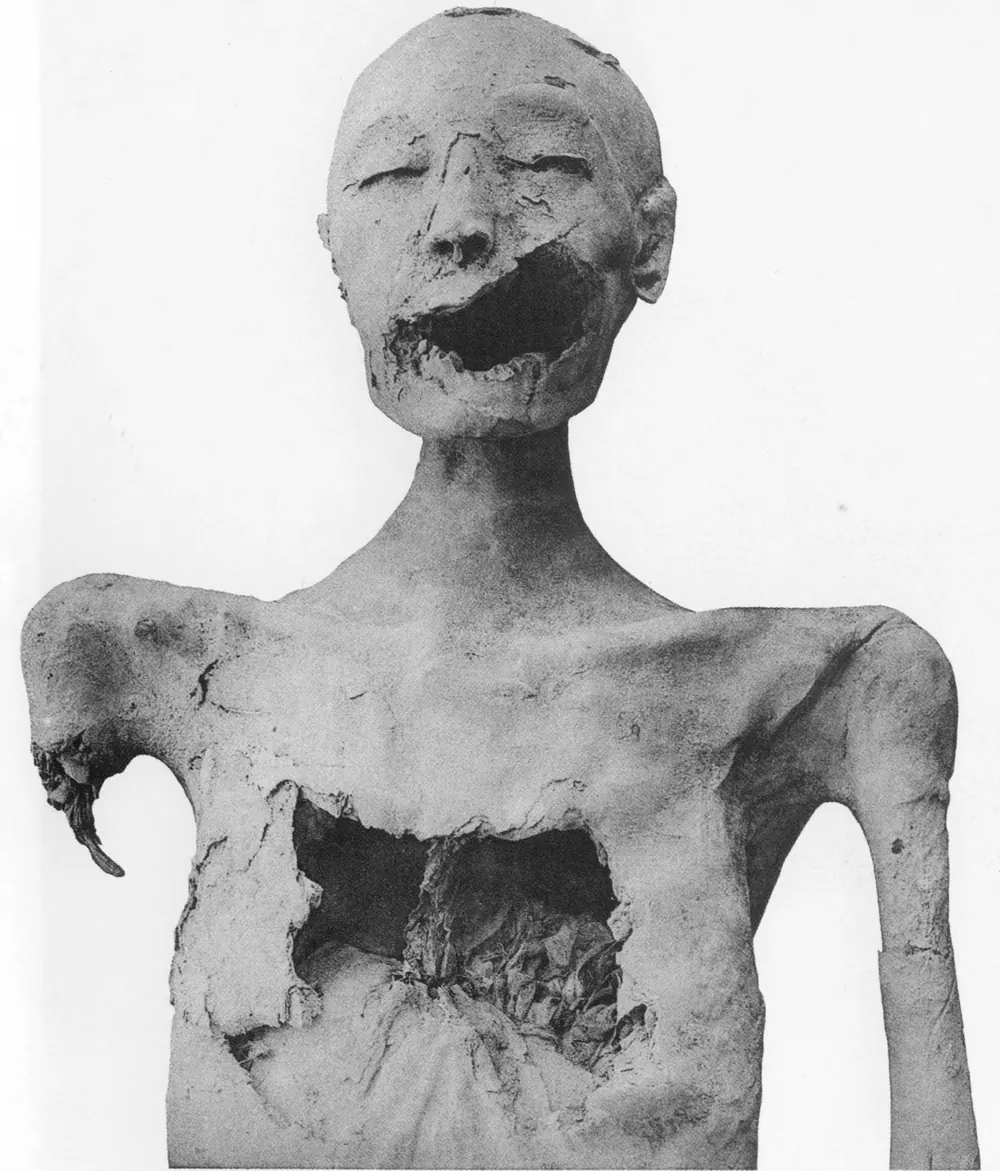
Dodson notes that Neferneferuaten’s kingly burial goods were never used for her but were instead appropriated for Tutankhamun, indicating that she was not buried as a king. He observes that this strongly suggests her reign ended badly. The trauma on the Younger Lady’s mummy, as the CT study reads it, is consistent with that assessment.
What Happened to Nefertiti?
Nefertiti’s ultimate fate is not demonstrably recorded in surviving inscriptions; any reconstruction is necessarily tentative. If she was not Pharaoh Neferneferuaten, then the question of her fate remains genuinely open. Her mummy has never been conclusively identified. No burial has been found. Her disappearance from the historical record after Year 16 is not necessarily evidence of death; it may be evidence of something else entirely.
What matters is that the evidence permits, though it does not require, an interpretation in which Nefertiti and Neferneferuaten are different women.
The Interpretation Adopted in The Amarna Mysteries
Every reconstruction of this period involves choices about which evidence to prioritize and which ambiguities to resolve in which direction. What I have tried to do is adopt interpretations that are consistent with the published evidence, that resolve as many contradictions as possible, and that provide the strongest foundation for the story.
The interpretation I adopted is this:
The Younger Lady (KV35YL) is an unnamed sister of Akhenaten, daughter of Amenhotep III and Tiye, and the biological mother of Tutankhamun. She ruled briefly as Pharaoh Ankhkheperure Neferneferuaten. In the novels she is murdered; the series takes the facial trauma on her mummy as the trace of that death. Her funerary equipment was appropriated for her son Tutankhamun’s burial.
The KV55 skeleton is Smenkhkare, not Akhenaten, consistent with the majority of skeletal age assessments and with Dodson’s own conclusion that the body is more likely a brother of Akhenaten than Akhenaten himself.
KV21A is Ankhesenamun, mother of Tutankhamun’s stillborn daughters, consistent with the DNA evidence and free of the incompatibility that arises from identifying KV55 as her father.
Nefertiti was Tutankhamun’s stepmother, never his birth mother, and never pharaoh. Her fate remains an open question, as it should.
Where the DNA evidence is clear, I have followed it. Where it permits multiple interpretations, I have chosen the reading that best resolves the contradictions while preserving the genuine mysteries. The enduring question of what happened to Nefertiti is one of those mysteries, and I believe it deserves to remain one.
Related Articles
The Royal Women of the Amarna Period — Nefertiti, Kiya, and the daughters at the center of the succession debate.
The Royal Family Tree — How Akhenaten, Nefertiti, the Younger Lady, Smenkhkare, and Tutankhamun connect across the disputed Amarna lineage.
Succession and Aftermath — The broader crisis between Akhenaten’s death and Tutankhamun’s coronation.
Akhenaten and the Aten Revolution — The reign that created the political conditions for Neferneferuaten’s rule.
Evidence and Power in the Amarna Period — How the archaeological record shapes what we know and what remains debated.
The Amarna Period: Overview — The broader historical context of the identity debate.
The Amarna Mysteries — The four-book series built on this history.
How The Amarna Mysteries Are Made — The creative and research process behind the series.
Further Reading
Allen, J.P., Two Altered Inscriptions of the Late Amarna Period (1988)
Allen, J.P., Nefertiti and Smenkh-ka-re (1994)
Allen, J.P., The Amarna Succession (2009)
Allen, J.P., The Amarna Succession Revised (2016)
Baker, B.J., King Tutankhamun’s Family and Demise (2010)
Belmonte, J.A., DNA, wine and eclipses, the Dahamunzu affaire (2013)
Brier, B., The Murder of Tutankhamen (1998)
Derry, D.E., Note on the Skeleton Hitherto Believed to Be That of King Akhenaten (1931)
Dodson, A., Amarna Sunset: Nefertiti, Tutankhamun, Ay, Horemheb, and the Egyptian Counter-Reformation (2009)
Dodson, A., Amarna Sunrise: Egypt from Golden Age to Age of Heresy (2014)
Dodson, A., Nefertiti, Queen and Pharaoh of Egypt: Her Life and Afterlife (2020)
Gabolde, M., D’Akhenaton à Toutânkhamon (1998)
Gabolde, M., Under a Deep Blue Starry Sky (2009)
Gabolde, M., L’ADN de la famille royale amarnienne et les sources égyptiennes (2013)
Gardiner, A.H., The Graffito from the Tomb of Pere (1928)
Harris, J.R., Nefernefruaten (1973)
Harrison, R.G., An Anatomical Examination of the Pharaonic Remains Purported to Be Akhenaten (1966)
Hawass, Z. et al., Ancestry and Pathology in King Tutankhamun’s Family (2010)
Kloska, M., The Role of Nefertiti in the Religion and the Politics of the Amarna Period (2017)
Krauss, R., Eine Regentin, ein König und eine Königin zwischen dem Tod von Achenaten und der Thronbesteigung von Tutanchaten (2007)
Lorenzen, E.D., Willerslev, E., King Tutankhamun’s Family and Demise (2010)
Luban, M., Do We Have the Mummy of Nefertiti? (1999)
Molleson, T., Cox, M., The Spitalfields Project, Volume 2: The Anthropology (1993)
Reeves, N., The Burial of Nefertiti? (2015)
Sambuelli, L. et al., The Third KV62 Radar Scan: Searching for Hidden Chambers Adjacent to Tutankhamun’s Tomb (2019)
Smith, G.E., The Royal Mummies (1912)
Van der Perre, A., The Year 16 Graffito of Akhenaten in Dayr Abū Ḥinnis (2014)

A.J. Tilke is the author of The Amarna Mysteries, a four-book historical fiction series set in ancient Egypt’s 18th Dynasty. The Poisoner’s Throne (Book 1) is planned for the fourth quarter of 2026, followed by The Restoration Trilogy — The Hittite Reckoning, The Restoration Murders, and The Dakhamunzu Affair — in the second quarter of 2027. A short-story anthology, The Twelve Hours of Night, will follow later.